minor piano scales pdf
Article Plan: Minor Piano Scales PDF
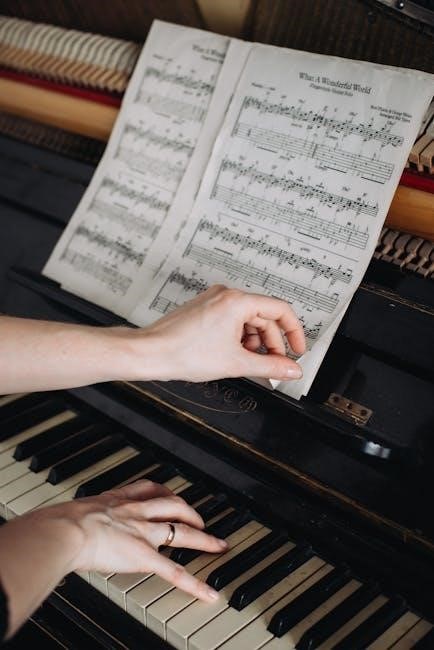
This article details minor piano scales, covering natural, harmonic, and melodic forms. PDF resources, key signatures, and practical exercises will be explored. Fingerings and common mistakes are addressed.
Enharmonic equivalents and sheet music examples (A, D, and Eb minor) will be provided, alongside tuning tips.
Minor scales form the bedrock of expressive piano music, often conveying feelings of sadness, introspection, or drama. Unlike their brighter counterparts, major scales, minor scales possess a distinct character that adds depth and nuance to musical compositions. Understanding these scales is crucial for any pianist aiming to interpret and perform a wide range of repertoire.
This guide focuses on minor piano scales, providing a comprehensive exploration of their construction, variations, and practical application. We’ll delve into the three primary types: natural, harmonic, and melodic, highlighting the subtle yet significant differences between them. The concept of relative scales – the close connection between major and minor keys sharing the same key signature – will be explained, offering a valuable shortcut for memorization and understanding.
PDF resources containing these scales are readily available online, and we’ll point you towards some excellent options. However, simply memorizing fingerings isn’t enough. We’ll emphasize the importance of understanding the why behind each alteration, fostering a deeper musical connection. Learning to identify minor scales in sheet music is also a key skill, and we’ll provide guidance on recognizing their characteristic patterns. Finally, we’ll touch upon enharmonic equivalents, like Eb minor and D minor, which can sometimes cause confusion.
Mastering minor scales unlocks a world of musical possibilities.
Understanding Key Signatures for Minor Scales
Key signatures are essential for navigating minor scales efficiently. They indicate which notes are consistently sharp or flat throughout a piece, eliminating the need for repeated accidentals. Understanding how key signatures relate to minor scales is fundamental to sight-reading and improvisation.
A crucial concept is the relationship between major and minor keys. Each major key has a relative minor, sharing the exact same key signature. To find the relative minor, descend a minor third (three semitones) from the major key’s tonic. For example, C major has no sharps or flats, and its relative minor, A minor, also has no sharps or flats.
Conversely, knowing a minor key’s signature allows you to quickly identify its relative major. Ascend a minor third from the minor key’s tonic. PDF resources often display scales with their corresponding key signatures, aiding memorization.
The number of sharps or flats in a key signature directly correlates to the scale’s complexity. As you progress to more altered minor scales (harmonic and melodic), the key signature remains the same as its relative major, but the application of those sharps or flats changes within the scale itself.
Consistent practice with scales and their key signatures builds fluency and confidence at the piano.
Relative Minor Scales: The Connection to Major Keys
Understanding the relationship between major and minor keys is pivotal for pianists. Every major key possesses a relative minor, and vice versa. This connection isn’t arbitrary; they share the identical key signature, simplifying scale learning and harmonic comprehension.
The method for finding a relative minor is straightforward: descend a minor third (three semitones) from the tonic of the major key. For instance, C major (no sharps or flats) has A minor as its relative minor – also with no sharps or flats. Conversely, to find the relative major, ascend a minor third from the minor tonic.
This shared key signature means that when analyzing PDF sheet music, recognizing a major key instantly reveals its relative minor, and vice versa. This knowledge streamlines identifying scales and chords within a piece.
Minor scales aren’t simply “versions” of major scales; they are distinct entities with their own character, yet intrinsically linked.

Utilizing this connection allows for efficient memorization and a deeper understanding of tonal harmony. Resources often highlight this relationship, aiding in practical application at the piano.
Types of Minor Scales: Natural, Harmonic, and Melodic
Minor scales aren’t monolithic; they exist in three primary forms: natural, harmonic, and melodic. Each variation possesses a unique intervallic structure, influencing its sound and harmonic function. Understanding these distinctions is crucial when studying minor piano scales PDF resources.
The natural minor scale is the most basic, derived directly from the major scale’s relative minor. It features a characteristic “somber” quality. The harmonic minor scale introduces a raised 7th degree, creating a stronger pull towards the tonic and a more dramatic sound. This alteration is vital for creating dominant chords in minor keys.
Finally, the melodic minor scale exhibits different ascending and descending forms. Ascending, it raises both the 6th and 7th degrees, smoothing out the interval between the 6th and 7th and creating a more lyrical quality; Descending, it reverts to the natural minor form.
PDFs often present all three forms side-by-side for comparison. Mastering these variations unlocks a broader palette of expressive possibilities for pianists and composers.
Natural Minor Scales ‒ Construction and Characteristics
Natural minor scales form the foundation for understanding minor tonality. Constructed by taking the 6th degree of a major scale, they establish a distinct mood often described as melancholic or introspective. A minor piano scales PDF will typically begin with this form due to its simplicity.
The interval pattern for a natural minor scale is whole-step, half-step, whole-step, whole-step, half-step, whole-step, whole-step. This results in a characteristic flattened 3rd, 6th, and 7th compared to its relative major scale. For example, A natural minor consists of A, B, C, D, E, F, and G.

PDF resources often highlight the relationship between natural minor and its relative major. Recognizing this connection simplifies key signature identification. The natural minor scale’s straightforward construction makes it an excellent starting point for learning minor scales, providing a solid base for exploring harmonic and melodic variations.
Understanding the inherent qualities of the natural minor scale is essential for interpreting and performing music written in a minor key.
Harmonic Minor Scales ‒ The Raised 7th
Harmonic minor scales introduce a crucial alteration to the natural minor: the raising of the 7th degree. This modification creates a stronger pull towards the tonic, enhancing the harmonic function and characteristic sound of the minor key. A comprehensive minor piano scales PDF will clearly demonstrate this change.
The raised 7th creates a leading tone, a half-step below the tonic, which is vital for creating dominant chords and cadences. For instance, in A harmonic minor, the G is raised to G#, resulting in the notes A, B, C, D, E, F, and G#. This alteration, however, introduces an augmented second interval between the 6th and 7th degrees, a unique characteristic of the harmonic minor.
PDF resources often emphasize the importance of recognizing this interval and its impact on voicing chords. Mastering the harmonic minor is essential for understanding classical and romantic repertoire, where its expressive potential is frequently utilized. Learning this scale is a key step in building a strong foundation in minor scales.
Melodic Minor Scales ⎯ Ascending and Descending Variations
Melodic minor scales present a fascinating departure from the natural and harmonic forms, exhibiting different characteristics when ascending versus descending. A detailed minor piano scales PDF will illustrate these variations, crucial for nuanced musical expression; Ascending, both the 6th and 7th degrees are raised, smoothing the augmented second interval found in the harmonic minor and creating a more lyrical sound.
For example, in A melodic minor ascending, the notes are A, B, C, D, E, F#, and G#. However, descending, the scale reverts to the natural minor form – A, G, F, E, D, C, and B. This descending form avoids the leading tone and the augmented second, offering a different harmonic color.
Understanding this duality is vital for pianists. PDF sheet music often indicates these alterations explicitly. Mastering both ascending and descending forms unlocks a wider range of melodic possibilities and harmonic textures. Practicing these variations diligently is key to fluency in minor scales and their application in musical performance.
A Minor Scale: A Detailed Example (Natural, Harmonic, Melodic)
Let’s examine A minor as a concrete example, readily available in many minor piano scales PDF resources. The A natural minor scale consists of A, B, C, D, E, F, and G – no sharps or flats. This forms the foundation, providing a melancholic and grounded sound. A minor piano scales PDF will visually represent this clearly.
The A harmonic minor scale introduces a raised 7th, becoming A, B, C, D, E, F, and G#. This creates a stronger pull towards the tonic (A) but introduces an augmented second between F and G#. This is a defining characteristic.
Finally, the A melodic minor scale differs ascending and descending. Ascending: A, B, C, D, E, F#, and G#. Descending: A, G, F, E, D, C, and B – reverting to the natural minor. A comprehensive PDF will showcase all three forms side-by-side. Practicing these variations builds technique and musical understanding, essential for any pianist exploring minor scales.
D Minor Scale: A Detailed Example (Natural, Harmonic, Melodic)
Let’s delve into the D minor scale, a frequently encountered scale in minor piano scales PDF materials. The D natural minor scale comprises D, E, F, G, A, Bb, and C. Notice the single flat – Bb – in its key signature. Many PDF resources visually highlight this.
The D harmonic minor scale alters the 7th degree, raising it to C#. This results in D, E, F, G, A, Bb, and C#. This alteration creates a leading tone, intensifying the resolution to D. A well-structured minor piano scales PDF will clearly illustrate this change.
The D melodic minor scale presents a unique characteristic. Ascending: D, E, F, G, A, Bb, and C#. Descending: D, C, Bb, A, G, F, and E – returning to the natural minor form. This ascending/descending difference is crucial. Finding a PDF with clear notation of both forms is vital for effective practice. Mastering these variations enhances your piano skills and musicality when working with minor scales.
Eb Minor Scale: A Detailed Example (Natural, Harmonic, Melodic)
Exploring the Eb minor scale, often found within comprehensive minor piano scales PDF guides, reveals its unique characteristics. The Eb natural minor scale consists of Eb, F, Gb, Ab, Bb, Cb, and Db. Observe the six flats in its key signature – a significant visual cue in PDF sheet music.
The Eb harmonic minor scale introduces a raised 7th, transforming Cb to C. This yields Eb, F, Gb, Ab, Bb, C, and Db. This alteration generates a stronger pull towards the tonic, Eb. Many minor piano scales PDF resources emphasize this harmonic function.
The Eb melodic minor scale exhibits its characteristic ascending/descending variation. Ascending: Eb, F, Gb, Ab, Bb, C, and Db. Descending: Eb, Db, Cb, Bb, Ab, Gb, and F – reverting to the natural minor form. Remember, the Eb minor scale is enharmonic to D minor, a point often clarified in PDF tutorials. Understanding these nuances is key to mastering minor scales and their application in piano performance.
Two-Octave Minor Scales: Expanding the Range
Progressing beyond single-octave practice, two-octave minor scales significantly enhance a pianist’s technical proficiency and musical understanding. Many minor piano scales PDF resources dedicate sections to these extended forms, recognizing their importance in developing fluency. Extending the range demands greater finger dexterity and coordination, skills crucial for tackling complex repertoire.
When navigating two-octave scales, maintaining consistent tone and rhythm is paramount. PDF guides often include suggested fingerings to optimize smoothness and efficiency. For example, the D harmonic minor, as depicted in some minor piano scales PDF examples, requires careful attention to the thumb tucks and finger crossings.
Practicing two-octave scales isn’t merely about reaching higher or lower notes; it’s about internalizing the scale’s structure across a broader landscape. This expanded range fosters a deeper connection to the key and prepares the pianist for more demanding passages found in piano literature. Consistent practice using PDF materials will yield noticeable improvements in technique and musicality.
Fingerings for Minor Scales: Optimizing Technique
Effective fingerings are crucial for playing minor scales with fluidity and accuracy. Many minor piano scales PDF resources prioritize clear fingering suggestions, recognizing that optimal technique minimizes tension and maximizes speed. Standard fingerings aim to distribute the workload evenly across all fingers, avoiding awkward stretches or repetitive strain.
For instance, when studying a minor piano scales PDF featuring the A natural minor scale, you’ll often find a consistent pattern of 1-2-3-1-2-3-4-5. This pattern, while seemingly simple, requires diligent practice to become automatic. Variations may exist depending on the scale and the pianist’s hand size, but the goal remains consistent: smooth transitions and efficient movement.
PDF guides often highlight thumb tucks and finger crossings as key areas for focused practice. Mastering these techniques allows for seamless navigation of the keyboard. Experimenting with different fingerings, while adhering to established principles, can help pianists discover what works best for their individual anatomy and playing style. Consistent application of correct fingerings, guided by PDF resources, builds lasting technical skill.
Practicing Minor Scales: Tips and Exercises
Consistent practice is paramount when mastering minor piano scales. Utilizing a minor piano scales PDF as a guide, begin slowly, focusing on accuracy and evenness of tone. Gradually increase tempo only when precision is maintained. A common exercise involves playing scales hands separately, then together, in various rhythms – dotted rhythms, triplets, and syncopated patterns.
Many PDF resources suggest practicing scales in different articulations: legato (smoothly connected) and staccato (short and detached). This develops finger dexterity and control. Incorporate inversions – starting on different notes of the scale – to enhance understanding of harmonic relationships. Regularly use a tuner to verify pitch accuracy, as highlighted in some PDF guides.
Beyond rote memorization, aim to internalize the sound of each scale. Improvise short melodies using the notes of the scale, fostering creativity and musicality. Minor piano scales PDF materials often include exercises for applying scales to chord progressions, bridging the gap between technical practice and musical expression. Remember, focused, deliberate practice yields the best results.
Minor Scales in Piano Literature: Common Examples
Minor scales permeate a vast repertoire of piano literature, lending emotional depth and character to countless compositions. Examining pieces utilizing these scales solidifies understanding beyond technical exercises found in a minor piano scales PDF. Chopin’s Nocturnes frequently employ minor keys, notably in Eb minor, showcasing the melancholic beauty of the harmonic and melodic forms.
Bach’s Preludes and Fugues, while often complex, demonstrate masterful use of minor scales, particularly in pieces like the Prelude and Fugue in C minor. Beethoven’s “Moonlight Sonata” (first movement) is a prime example of a piece deeply rooted in C# minor, illustrating the dramatic potential of the scale.
Liszt’s works, known for their virtuosity, often feature passages built upon minor scales, demanding technical proficiency. Studying these examples, alongside referencing a minor piano scales PDF, reveals how composers utilize scale patterns to create specific moods and textures. Recognizing these patterns in existing music enhances both analytical skills and performance interpretation.
Identifying Minor Scales in Sheet Music
Identifying minor scales within sheet music requires a keen eye for key signatures and melodic patterns. Unlike a minor piano scales PDF which presents scales in isolation, real music presents them contextually. Look first at the key signature – a flat in the key signature often indicates a minor key, though not always definitively.
Examine the tonic (root) note of the piece. If the piece feels centered around a minor chord, it’s a strong indicator. Analyze the intervals within melodic phrases. A minor scale has a characteristic flattened third, distinguishing it from its major counterpart.
Pay attention to accidentals. The raised 7th in harmonic minor, or the raised 6th and 7th in melodic minor (ascending), are crucial clues. Comparing the melody to a minor piano scales PDF can confirm your analysis. Recognizing these patterns builds aural and visual skills, allowing for quicker identification and deeper musical understanding.
Enharmonic Equivalents in Minor Scales (e.g., Eb minor & D minor)
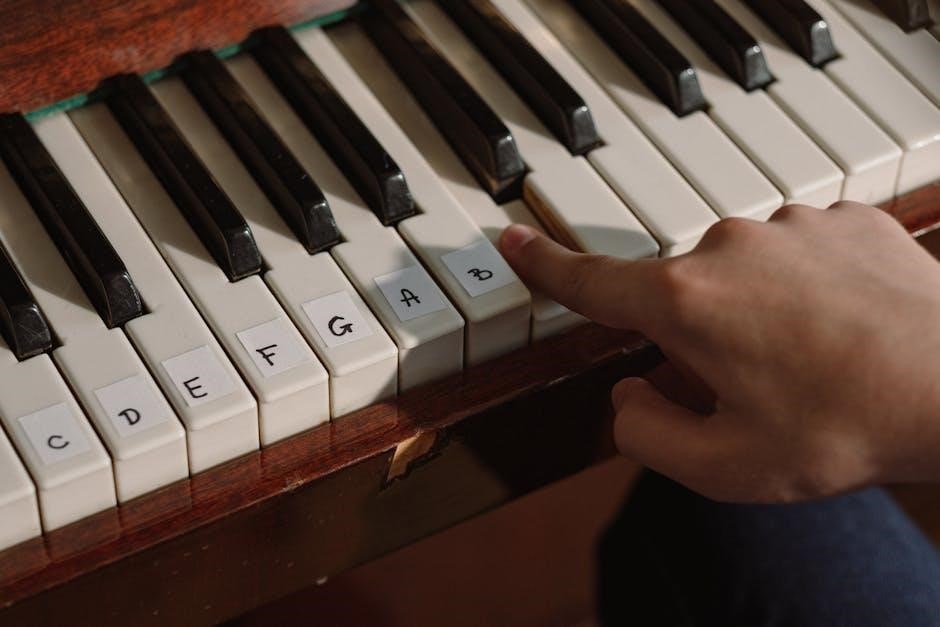
Enharmonic equivalents are notes that sound the same but are written differently. In the context of minor piano scales PDF study, understanding these is crucial. For example, Eb minor and D minor scales share the exact same pitches on the piano keyboard, despite differing notation.
This occurs because of how sharps and flats are used to construct scales. While D minor utilizes sharps, Eb minor employs flats. This doesn’t change the sound, only the visual representation on the staff. A minor piano scales PDF might present both, highlighting their identical fingerings.

Recognizing enharmonic equivalents aids in transposition and understanding musical relationships. It also prevents confusion when reading music in different keys. When practicing from a minor piano scales PDF, be aware that a scale might have an enharmonic equivalent, offering flexibility in performance and theoretical comprehension.

Resources for Minor Scale PDFs: Online Sheet Music
Finding reliable minor piano scales PDF resources is essential for effective practice. Several websites offer free and paid sheet music, catering to various skill levels. Pianostreet.com, for instance, provides downloadable sheet music, including minor scales, though copyright restrictions apply – always check usage rights.
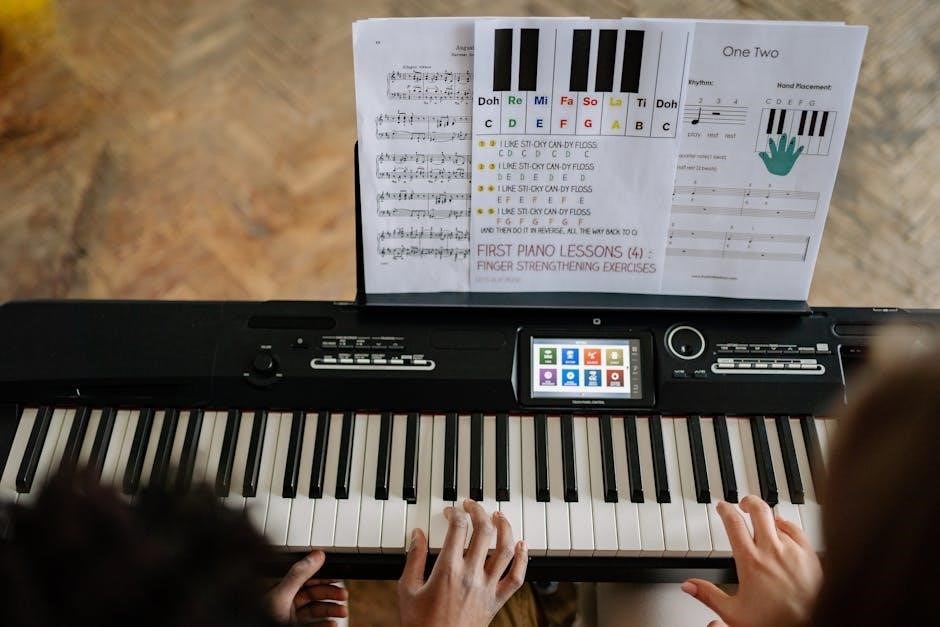
Many music education websites and online stores also host collections of scales in PDF format. A simple web search for “minor scales piano PDF” yields numerous results. However, prioritize sources with clear notation and accurate fingerings.
Consider websites offering interactive minor piano scales PDF options, allowing you to play along or adjust the tempo. Muted.io provides an interactive music theory cheat sheet, useful for visualizing scales. Remember to supplement online resources with a solid understanding of music theory and proper technique. Always verify the accuracy of any downloaded minor piano scales PDF before incorporating it into your practice routine.
Using a Tuner to Verify Pitch Accuracy
Maintaining accurate pitch is crucial when practicing minor piano scales PDF exercises. Even slight inaccuracies can hinder your ear training and overall musical development. A digital tuner – either a physical device or a smartphone app – is an invaluable tool for verifying pitch accuracy.
When practicing scales, play each note slowly and deliberately, checking its pitch against the tuner. Pay close attention to any deviations from the correct frequency. Consistent use of a tuner helps you identify and correct intonation issues, ensuring you’re playing in tune.
Furthermore, a tuner can help you develop a stronger internal sense of pitch. By regularly comparing your playing to a reliable reference, you’ll gradually improve your ability to recognize and produce accurate notes. Remember, the goal isn’t to rely on the tuner indefinitely, but to use it as a learning aid to refine your ear and technique when working with minor piano scales PDF materials.
Common Mistakes When Learning Minor Scales
When tackling minor piano scales PDF exercises, several common pitfalls can impede progress. A frequent error is neglecting the distinct characteristics of each minor scale type – natural, harmonic, and melodic. Students often default to the natural minor, forgetting the raised 7th in harmonic minor or the ascending/descending variations in melodic minor.
Another mistake is improper fingering. Incorrect fingerings lead to awkward transitions and hinder speed and fluency. Refer to established fingering patterns and practice slowly to build muscle memory. Additionally, rushing the learning process is detrimental. Scales require deliberate, focused practice to internalize the patterns and develop accurate technique.
Failing to connect scales to key signatures is also a common issue. Understanding the relationship between key signatures and scale construction is vital. Finally, neglecting to use a tuner (as previously discussed) can reinforce inaccurate pitch habits. Consistent attention to these details will significantly improve your minor piano scales PDF practice.
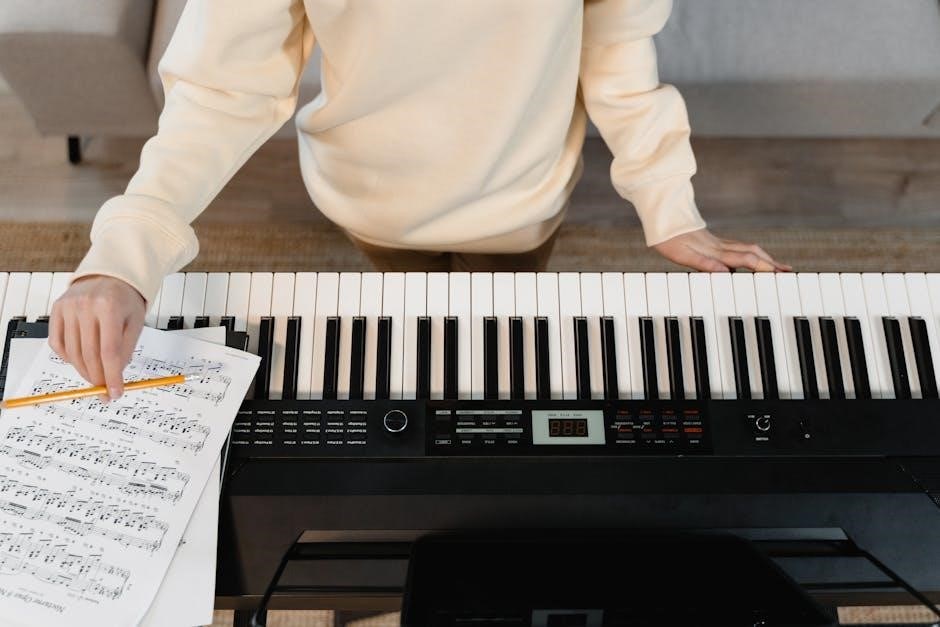
Mastering Minor Scales for Piano
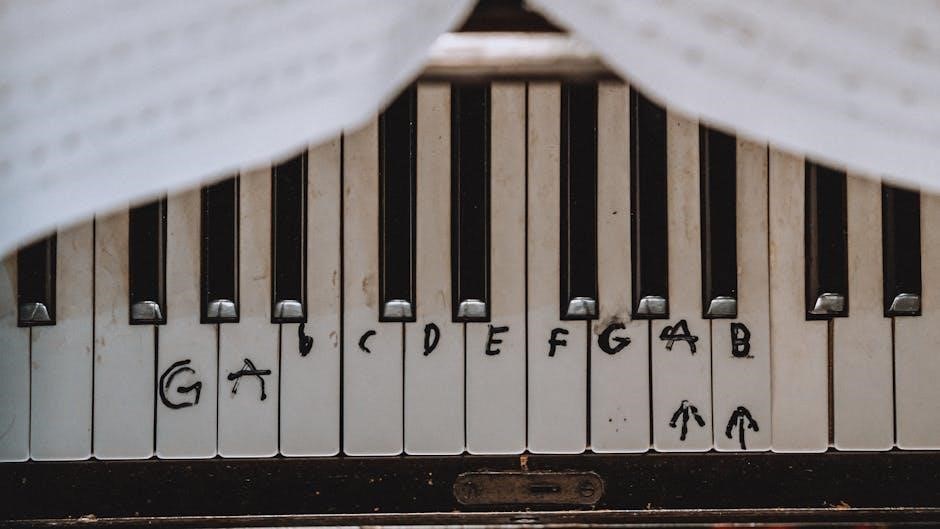
Mastering minor piano scales, utilizing resources like a minor piano scales PDF, is fundamental to a pianist’s development. Consistent practice, focusing on accuracy and fluency, unlocks a deeper understanding of music theory and enhances improvisational skills. Remember the nuances of natural, harmonic, and melodic forms, and diligently apply correct fingerings.
Don’t underestimate the value of slow, deliberate practice with a tuner to ensure pitch accuracy. Recognizing key signatures and understanding enharmonic equivalents (like Eb minor and D minor) broadens your musical comprehension. Explore scales within piano literature to contextualize your learning.
Ultimately, proficiency in minor scales isn’t merely about technical execution; it’s about cultivating a musical ear and unlocking expressive potential. By addressing common mistakes and embracing consistent practice, you’ll build a solid foundation for musical growth. PDF resources are excellent tools, but dedicated practice remains key.